MMD ORALS QUESTIONS
1. Indian Merchant Shipping Act: [13 hrs]
a. Registration of ships. The certificate of registry and its legal significance. [2 hrs]
b. Engagement, discharge and management of crew. Manning scales and certification. Contracts of employment, wages and other remuneration, advances, allotments, payment into bank accounts. Descriptions, deceased seamen, engagement of substitutes, repatriation, assisting and repatriating Indian seamen distressed abroad. [2 hrs]
c. The official log book and the law relating to entries. Offences relating to misconduct, to endangering ship and against persons on board. Discipline and treatment of disciplinary offences. Civil liability for certain offences. Trade disputes involving seamen. The official log book entries and records in freeboard draft and allowances. [2 hrs]
d. Crew accommodation. Hygiene of the ship and welfare of the crew. An outline knowledge of the regulations relating to medical stores. Inspection and reports. Fresh water and provisions. Procedures in cases of infectious disease, illness or accidents. Maritime declarations of health. Port health requirements. International agreements and measures to prevent the spread of disease by shipping. [2 hrs]
e. The safety of the ship, crew and passengers. Assistance of vessels in distress and salvage. Master’s duties in the case of collision or any other accident. Master’s role in collecting evidence after an accident. Lodging protests etc. Inquiries and Investigation. [3 hrs]
f. The law relating to the reporting of ice, derelict, tropical revolving storms and other dangers to navigation. [1 hr]
g. To have an outline knowledge of the rules made under the Merchant Shipping Act. [1 hr]
2. Documentation: Certificates and other documents required to be carried on Passenger ships, tankers, Gas carriers, Chemical carriers, Car/Truck carriers, Bulk carriers, etc. How they are obtained and the period of their validity. Suez and Panama Canal certificates. Other Trading certificates that are required to be carried on board such as CFR etc.
[3 hrs]
3. Custom house procedures: Inward and outward clearance, Immigration clearance, quarantine clearance (FAL Convention). [2 hrs]
4. Methods of dealing with stowaways, hijacking of ships, armed robbery / piracy, smuggling and other custom offences, drug and alcohol policy and its enforcement.
[6 hrs]
5. Master – Pilot relationship: Exchange of information, responsibilities. Compulsory and optional pilotage. Bridge Team Management while under pilotage. Legal implications if an incident occurs when under pilotage. [4 hrs]
6. Economics of sea transport theory of international trade, general structure of shipping industry relationship between ship-owner, agent, stevedore, charterer, shipper and broker. Detailed knowledge of voyage estimates including cargo calculations involving deadweight, loadline zones, consumables and constants taking into account various charges, receipts and establishing economic viability. [12 hrs]
7. A general knowledge of shipping practice and documents with particular reference to charter parties and its Main clauses, bills of lading and its Main clauses and mates receipts for various types of ships and trades including tanker practice, meaning of the terms used in chartering practice such as AFRA, WORLDSCALE,INCOTERMS.
[3 hrs]
An understanding of the main clauses in a contract of affreightment including freight, deviation, always afloat, ice, laydays, demurrage and dispatch including calculations involving laydays, charter party, etc. The law relating to the carriage of cargo and ship-owners’, liabilities and responsibilities. Protests, cargo surveys, certificates of seaworthiness. Hague rules, Hague – Visby rules, Hamburg rules, Rotterdam Rules COGSA, Multimodal Transport Act. Handling of claims and disputes related to Charter parties.
[16 hrs]
8. An outline knowledge of the expressed and implied conditions and statutory terms contained in a contract of marine insurance. Institute clauses. An understanding of principles and practice of the terms; particular average, general average. Procedure at a port of refuge. Lloyd’s agents. Average adjusters. P & I clubs, LOF 2000, Scopic clause. Warranties, CLC, Fund convention, York-Antwerp rules.
[15 hrs]
9. International institutions such as IMO, ILO, WHO, ISF, IACS, BIMCO, ICS, OCIMF, SIGTTO,INTERTANKO,INTERCARGO,WTO,IMCA,IFSMA,WMU,IMLI etc. and classification societies. [2 hrs]
10. Latest changes in national and international maritime legislation pertaining to SOLAS, MARPOL, Load line and STCW. [6 hrs]
11. Control procedures: Classification surveys, Flag State Control, Port State Control, Charterer’s vetting inspections, inspections by port terminal authorities, Condition surveys.
[3 hrs]
12. Principles and practice of modern ship management w.r.t ISPS Code, ISM Code including methods to prevent human errors on ship, Human Resource Development.
[6 hrs]
13. Casualty Investigation Code. Criminalisation of seafarers: Seafarers Rights under a Casualty investigation. Case Studies. Reporting of Incidents (Report Writing).
[4 hrs]
14. Musters and drills, distress/urgency/safety messages. Avoidance of False distress alerts and action in case of false distress alert. Search and Rescue, steps to be taken when disabled & in distress, assisting a ship or aircraft in distress. IAMSAR.
[3 hrs]
15. Place of refuge procedures. Wreck and Salvage, legal implications.
[3 hrs]
16. Lighterage operations, Ocean Towing. (Towing & Towed vessel), Emergency Towing arrangements, Maritime Assistance Service on Indian coast (being developed)
[2 hrs]
17. Emergency Response Procedures: Fire in Port & at Sea, grounding, collision, knowledge of collision mats, Pollution, Flooding, Engine failure, Listing, Beaching, Steering failure, refloating of vessel. Man-overboard, Helicopter Rescue Operation, piracy and armed robbery. [8 hrs]
18. Case Studies: (MSC Chitra and Khalijia 3, M.V.Tosa, Hebei Spirit and Samsung crane barge, Herald of Free Enterprise, Cosco Busan)
[8 hrs]
19. Anchoring & Berthing under the effect of tide / wind in shallow / deep waters, use of Anchors, squat, interaction between ships / shore, transverse Thrust & turning the ship short round, pivot point, dragging / dredging anchors. [6 hrs]
20. Manoeuvering and handling of ship in all conditions. Synchronous rolling, Parametric rolling, wind heeling criteria for high freeboard ships. Emergency stopping manoeuvres, crash stop, rudder cycling. [6 hrs]
21. Maritime Labour Convention (MLC-2006)
a) Minimum requirements for seafarers to work on ships: minimum age, medical certificates, training and qualification, recruitment and placement.
b) Conditions of Employment: Seafarers Employment Agreements, Wages, Hours of Work and Hours of Rest, Entitlement to Leave, Repatriation, Seafarer compensation for the ship’s Loss or Foundering, Manning Levels, Career and Skill Development and Opportunities for Seafarers’ Employment
c) Accommodation, Recreational Facilities, Food and Catering
d) Health Protection, Medical Care, Welfare & Social Security Protection: Medical Care on-board ship and Ashore, Ship-owners’ Liability, Health & Safety Protection and Accident Prevention, Access to Shore-based Welfare Facilities, Social Security
e) Compliance and Enforcement
i) Flag State Responsibilities: General Principles, Authorization of Recognised Organizations, Maritime Labour Certificate and Declaration of Maritime Labour Compliance, Inspection and Enforcement, On-board Complaint Procedures, Marine Casualties
ii) Port State Responsibilities: Inspections in Port, Detailed Inspection, Detentions, On-shore Seafarer Complaint Handling Procedures
iii) Labour-supplying Responsibilities: Recruitment and Placement services, Social security provisions
[6 hrs]
22. Environmental Protection: Marpol Annexes, SOPEP/SMPEP, Vessel Response Plan, oil record book. Ballast Water Management, OPA 90 & NPDES. (National Pollution Discharge Elimination System of U.S.A.) [3 hrs]
23. Operating in ice: Basic ship handling in ice, sighting of ice / open water, working through ice, navigation in ice, effects of ice accretion on stability of vessel.
High latitude Navigation – procedures & precaution. Polar Code. [4 hrs]
24. Damage Stability Criteria and Damage stability booklet. [2 hrs]
25. Weather Routeing: [2 hrs]
26. Various ship plans used in Cargo Loading / discharging, dry docking, Grounding, Dry-docking both intact and with damage; Preparation of Repair Specifications etc.
[4 hrs]
27. COLREGS and related case studies [16 hrs]
28. Ship Recycling Convention: Hazardous Materials inventory, Green Passport. [2 hrs]
29. Global Warming and climate change: [3 hrs]
30. Dangerous Goods: IMDG code, [3 hrs]
31. Assessment & Feedback. [4 hrs]
a. Registration of ships. The certificate of registry and its legal significance. [2 hrs]
b. Engagement, discharge and management of crew. Manning scales and certification. Contracts of employment, wages and other remuneration, advances, allotments, payment into bank accounts. Descriptions, deceased seamen, engagement of substitutes, repatriation, assisting and repatriating Indian seamen distressed abroad. [2 hrs]
c. The official log book and the law relating to entries. Offences relating to misconduct, to endangering ship and against persons on board. Discipline and treatment of disciplinary offences. Civil liability for certain offences. Trade disputes involving seamen. The official log book entries and records in freeboard draft and allowances. [2 hrs]
d. Crew accommodation. Hygiene of the ship and welfare of the crew. An outline knowledge of the regulations relating to medical stores. Inspection and reports. Fresh water and provisions. Procedures in cases of infectious disease, illness or accidents. Maritime declarations of health. Port health requirements. International agreements and measures to prevent the spread of disease by shipping. [2 hrs]
e. The safety of the ship, crew and passengers. Assistance of vessels in distress and salvage. Master’s duties in the case of collision or any other accident. Master’s role in collecting evidence after an accident. Lodging protests etc. Inquiries and Investigation. [3 hrs]
f. The law relating to the reporting of ice, derelict, tropical revolving storms and other dangers to navigation. [1 hr]
g. To have an outline knowledge of the rules made under the Merchant Shipping Act. [1 hr]
2. Documentation: Certificates and other documents required to be carried on Passenger ships, tankers, Gas carriers, Chemical carriers, Car/Truck carriers, Bulk carriers, etc. How they are obtained and the period of their validity. Suez and Panama Canal certificates. Other Trading certificates that are required to be carried on board such as CFR etc.
[3 hrs]
3. Custom house procedures: Inward and outward clearance, Immigration clearance, quarantine clearance (FAL Convention). [2 hrs]
4. Methods of dealing with stowaways, hijacking of ships, armed robbery / piracy, smuggling and other custom offences, drug and alcohol policy and its enforcement.
[6 hrs]
5. Master – Pilot relationship: Exchange of information, responsibilities. Compulsory and optional pilotage. Bridge Team Management while under pilotage. Legal implications if an incident occurs when under pilotage. [4 hrs]
6. Economics of sea transport theory of international trade, general structure of shipping industry relationship between ship-owner, agent, stevedore, charterer, shipper and broker. Detailed knowledge of voyage estimates including cargo calculations involving deadweight, loadline zones, consumables and constants taking into account various charges, receipts and establishing economic viability. [12 hrs]
7. A general knowledge of shipping practice and documents with particular reference to charter parties and its Main clauses, bills of lading and its Main clauses and mates receipts for various types of ships and trades including tanker practice, meaning of the terms used in chartering practice such as AFRA, WORLDSCALE,INCOTERMS.
[3 hrs]
An understanding of the main clauses in a contract of affreightment including freight, deviation, always afloat, ice, laydays, demurrage and dispatch including calculations involving laydays, charter party, etc. The law relating to the carriage of cargo and ship-owners’, liabilities and responsibilities. Protests, cargo surveys, certificates of seaworthiness. Hague rules, Hague – Visby rules, Hamburg rules, Rotterdam Rules COGSA, Multimodal Transport Act. Handling of claims and disputes related to Charter parties.
[16 hrs]
8. An outline knowledge of the expressed and implied conditions and statutory terms contained in a contract of marine insurance. Institute clauses. An understanding of principles and practice of the terms; particular average, general average. Procedure at a port of refuge. Lloyd’s agents. Average adjusters. P & I clubs, LOF 2000, Scopic clause. Warranties, CLC, Fund convention, York-Antwerp rules.
[15 hrs]
9. International institutions such as IMO, ILO, WHO, ISF, IACS, BIMCO, ICS, OCIMF, SIGTTO,INTERTANKO,INTERCARGO,WTO,IMCA,IFSMA,WMU,IMLI etc. and classification societies. [2 hrs]
10. Latest changes in national and international maritime legislation pertaining to SOLAS, MARPOL, Load line and STCW. [6 hrs]
11. Control procedures: Classification surveys, Flag State Control, Port State Control, Charterer’s vetting inspections, inspections by port terminal authorities, Condition surveys.
[3 hrs]
12. Principles and practice of modern ship management w.r.t ISPS Code, ISM Code including methods to prevent human errors on ship, Human Resource Development.
[6 hrs]
13. Casualty Investigation Code. Criminalisation of seafarers: Seafarers Rights under a Casualty investigation. Case Studies. Reporting of Incidents (Report Writing).
[4 hrs]
14. Musters and drills, distress/urgency/safety messages. Avoidance of False distress alerts and action in case of false distress alert. Search and Rescue, steps to be taken when disabled & in distress, assisting a ship or aircraft in distress. IAMSAR.
[3 hrs]
15. Place of refuge procedures. Wreck and Salvage, legal implications.
[3 hrs]
16. Lighterage operations, Ocean Towing. (Towing & Towed vessel), Emergency Towing arrangements, Maritime Assistance Service on Indian coast (being developed)
[2 hrs]
17. Emergency Response Procedures: Fire in Port & at Sea, grounding, collision, knowledge of collision mats, Pollution, Flooding, Engine failure, Listing, Beaching, Steering failure, refloating of vessel. Man-overboard, Helicopter Rescue Operation, piracy and armed robbery. [8 hrs]
18. Case Studies: (MSC Chitra and Khalijia 3, M.V.Tosa, Hebei Spirit and Samsung crane barge, Herald of Free Enterprise, Cosco Busan)
[8 hrs]
19. Anchoring & Berthing under the effect of tide / wind in shallow / deep waters, use of Anchors, squat, interaction between ships / shore, transverse Thrust & turning the ship short round, pivot point, dragging / dredging anchors. [6 hrs]
20. Manoeuvering and handling of ship in all conditions. Synchronous rolling, Parametric rolling, wind heeling criteria for high freeboard ships. Emergency stopping manoeuvres, crash stop, rudder cycling. [6 hrs]
21. Maritime Labour Convention (MLC-2006)
a) Minimum requirements for seafarers to work on ships: minimum age, medical certificates, training and qualification, recruitment and placement.
b) Conditions of Employment: Seafarers Employment Agreements, Wages, Hours of Work and Hours of Rest, Entitlement to Leave, Repatriation, Seafarer compensation for the ship’s Loss or Foundering, Manning Levels, Career and Skill Development and Opportunities for Seafarers’ Employment
c) Accommodation, Recreational Facilities, Food and Catering
d) Health Protection, Medical Care, Welfare & Social Security Protection: Medical Care on-board ship and Ashore, Ship-owners’ Liability, Health & Safety Protection and Accident Prevention, Access to Shore-based Welfare Facilities, Social Security
e) Compliance and Enforcement
i) Flag State Responsibilities: General Principles, Authorization of Recognised Organizations, Maritime Labour Certificate and Declaration of Maritime Labour Compliance, Inspection and Enforcement, On-board Complaint Procedures, Marine Casualties
ii) Port State Responsibilities: Inspections in Port, Detailed Inspection, Detentions, On-shore Seafarer Complaint Handling Procedures
iii) Labour-supplying Responsibilities: Recruitment and Placement services, Social security provisions
[6 hrs]
22. Environmental Protection: Marpol Annexes, SOPEP/SMPEP, Vessel Response Plan, oil record book. Ballast Water Management, OPA 90 & NPDES. (National Pollution Discharge Elimination System of U.S.A.) [3 hrs]
23. Operating in ice: Basic ship handling in ice, sighting of ice / open water, working through ice, navigation in ice, effects of ice accretion on stability of vessel.
High latitude Navigation – procedures & precaution. Polar Code. [4 hrs]
24. Damage Stability Criteria and Damage stability booklet. [2 hrs]
25. Weather Routeing: [2 hrs]
26. Various ship plans used in Cargo Loading / discharging, dry docking, Grounding, Dry-docking both intact and with damage; Preparation of Repair Specifications etc.
[4 hrs]
27. COLREGS and related case studies [16 hrs]
28. Ship Recycling Convention: Hazardous Materials inventory, Green Passport. [2 hrs]
29. Global Warming and climate change: [3 hrs]
30. Dangerous Goods: IMDG code, [3 hrs]
31. Assessment & Feedback. [4 hrs]
Q 2. What is a new danger? How will you mark them? What is duplication?
A new danger is a newly discovered hazard to navigation that is
not yet indicated on charts or Sailing Directions and has not been
sufficiently published in Notices to Mariners. This situation arises
with newly discovered natural dangers such as rocks or banks but is
mainly used to mark recent wrecks.
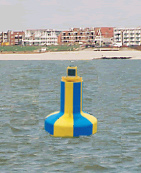
The new buoys will be blue and yellow vertical stripes with an alternating blue and yellow occulting light.
equal width. The abbreviation of the colour will be BuY.
These buoys will remain on station until:
• The wreck is well known and has been promulgated in nautical publications;
• The wreck has been fully surveyed and exact details such as position and least depth
above the wreck are known;
• A permanent form of marking of the wreck has been carried out.
New danger. Attention is being drawn to the fact that a “new danger” that has not yet been announced in nautical documents may be indicated with a duplicating mark being identical (in all details) with the principal mark. The duplicating mark should stay until the news about the new danger has been adequately announced. The “new danger” mark should be equipped with a Racon sending out the letter “D” in the Morse Code
The new buoys will be blue and yellow vertical stripes with an alternating blue and yellow occulting light.
Shape
A pillar of spar buoy, the size dependent upon the situation.Colour
Between 4 and 8 vertical blue and yellow stripes, these stripes will be ofequal width. The abbreviation of the colour will be BuY.
Light
An alternating blue and yellow flashing light with a nominal range of 4 nautical miles, the blue and yellow 1 second flashes are alternated with an interval of 0.5 seconds. Bu1.0s+0.5s+Y1.0s+0.5s= 3.0sTopmark
The top mark, if fitted, is to be a standing/upright yellow cross. (This shape is new for the IALA Buoyage System.)These buoys will remain on station until:
• The wreck is well known and has been promulgated in nautical publications;
• The wreck has been fully surveyed and exact details such as position and least depth
above the wreck are known;
• A permanent form of marking of the wreck has been carried out.
New danger. Attention is being drawn to the fact that a “new danger” that has not yet been announced in nautical documents may be indicated with a duplicating mark being identical (in all details) with the principal mark. The duplicating mark should stay until the news about the new danger has been adequately announced. The “new danger” mark should be equipped with a Racon sending out the letter “D” in the Morse Code
What are the systematic searches you will carry out? Where will you get details of the RCC for Rotterdam area?
- Expanding Square search (SS)
- if location of the object is known within relatively close limits
- Not too many vsls can take part as the area is very small
- Accurate navigation reqd
- Commencement point is the datum
- Sector Search
- Most effective if search object is accurately know and search area is small (2-5 NM for vessels)
- Not to be used by multiple crafts/vessels as area is small
- Each turn is 120 degree and normally to stbd
- A marker-smoke buoy or radio beacon- is dropped at datum as reference point


- Track Line Search (TS)
- Normally used when an aircraft or vessel has disappeared without a trace along a known route.
- Often used as initial search effort due to ease of planning and implementation.
- Consists of a rapid and reasonably thorough search along intended route of the distressed craft.
- Search may be along one side of the track line and return in the opposite direction on the other side (TSR).
- Search may be along the intended track and once on each side, then search facility continues on its way and does not return (TSN).
- Aircraft are frequently used for TS due to their high speed.


- Parallel Sweep Search (PS)
- Used to search a large area when survivor location is uncertain.
- Most effective over water or flat terrain.
- Usually used when a large search area must be divided into sub-areas for assignment to individual search facilities on-scene at the same time.
- The commence search point is in one corner of the sub-area, one-half track space inside the rectangle from each of the two sides forming the corner.
- Search legs are parallel to each other and to the long sides of the sub-area.


- Contour search by airplanes
Track Spacing (S): The distance between adjacent tracks in a search pattern of a rescuing ship is called track spacing. The distance ‘S’ between
tracks is found out from the table given in IAMSAR based on object of
search and the visibility. An appropriate weather correction factor ‘fw’
is applied depending on prevailing wind force. Radius is normally
taken as 10NM if search is to be commenced immediately otherwise it is
calculated..
A seaman complains of excessive noise in his cabin from the AC motor in the AC plant next to his cabin, action?
- SOLAS Reg 36 Ch II-I (Protection against noise)
- Investigate the problem
- Repair the motor
- Insulate / isolate the equipment
- Make refuse from noise
- Measures shall be taken to reduce machinery space.
- If possible to shift cabin
- Make report to Superintendent
(If Indian ship, will note down in the grievance register ha ha ha ! No, seriously ! Anbody sailed in SCI? )
Q1. What FFA you have only on a tanker
Fixed Foam System (Will elaborate with a link later)
How will you do internal audit?
- As per instructions mentioned in SMS
- Structured checklist form for internal audit.
Can C/O do the internal audit of E/R and vice versa
- Internal audits are carried out within the company preferably by suitably qualified personnel not from the department or ship being audited.
- Auditors should not be directly involved in area, deptt or activity being audited
- Master being principal authority on ship, should not audit the vessel, he is in command of but may do so on his appointment prior taking over the command
- Yes, if written in SMS
What is cargo record book?
- Required as per MARPOL Annex II Regulation 15
- Applicable to all ships to which Ann II applies i.e., All ships certified to carry NLS in bulk
- Entry to be made promptly after completion of any operation
- Each entry to be signed by officer in charge and each page to be signed by the master of the ship
- Entries in English, French, Spanish or national language of flag state
- To be retained for 3 years after last entry
- Copies may be made by competent authority of PSC OR FSI and same will be required by the master to certify as true
Appendix 2 to Annex II
Entries to be made:
- Loading of cargo
- Internal transfer of cargo
- Unloading of cargo
- Mandatory pre-wash in accordance with ship’s P&A Manual
- Cleaning of cargo tanks except mandatory prewash (other prewash operations, final wash, ventilation etc)
- Discharge into the sea of tank washings
- Ballasting of cargo tanks
- Discharge of ballast water from cargo tanks
- Accidental or other exceptional discharge
- Control by authorised surveyors
- Additional operational procedures and remarks
What is accelerating turn?
Ship accelerates from rest with the engine full
manoeuvring speed ahead and the maximum rudder angle. Data are presented
for both full load and ballast conditions.
ANOTHER LINKS
http://www.mcaorals.co.uk/Index.htm
ANOTHER LINKS
http://www.mcaorals.co.uk/Index.htm

No comments:
Post a Comment